
Process Journal for a String Mountain
What if the gold needs to stay in the ground?

The carabinier is cold to touch. Hot pink with a cobalt blue closure.
‘We have plenty, if you need more,’ my mountaineering friend says to me as he passes me the bright thing.
‘One will be enough,’ I say. It’s cool in my palm and light. Immediately it begins to warm against my skin. I wonder where it has been? Which mountains? Or simply in the garage until now? My friend stands against a backdrop of flax which shakes in the breeze. Banks of grey cloud bloom towards rain. I don’t ask. Not all questions need answers.
In Dunedin, with the carabinier in my pocket, I put my phone on the carpet where I might fall next to it. The big old shop at 125 George Street has walls painted the powdery-teal of the Ahuriri river. Long glass windows catch street noise and cast it into the space. Bricks hum.
I begin to sing. A gentle reverb echoes back.
Out on the street the group of homeless people, who have made the shop door their day-time home, talk: loud, soft, loud again. I will learn, over the course of the next six weeks, that the doorway provides good shelter from heavy north-east winds, and freezing southerlies; and that the power-box to the right of the door is a favourite spot for many to sit and vape. The homeless men wear dark colours, their conversation ripples with tension. They don’t look into the shop at me on the ladder. They wait, backs to the glass staring out. One flips a skateboard continuously. Clack, clack.
I’ve take off my boots, then socks. The carpet has an acrylic tack under my bare soles. I climb. The ladder rungs are cool, bevelled with grippy lines. Surfing has given me good balance. I rest in this confidence. There’s a giddy freedom being in the vast space of the building alone. Except, I’m not alone. My dog Tiger is stretched out sleeping on a camp mat while I work.
Up on the ladder, I clip the carabinier to a lighting bracket.
Outside, a young man arrives and gives the waiting homeless men a meal each. They go quiet while they eat, then disperse.
I thread black hemp string through the carabinier. The string is rough on my finger-tips and leaves a stain. The string glides with incredible ease through the device. I climb down and wind the string around a rock. Up and down the ladder I go threading and anchoring. Seven long strings to fourteen rocks. I make a grid for a mountain.
‘I set up a grid when I paint,’ artist Claire Beynon told me once, ‘Then the grid falls away.’
I have forty-two poems and twenty-two artworks. The overall harmony of the string mountain relies on a basic mathematical pattern, with three to five works per string-line. There will be forty-two days for the installation, and three response trees. We will start on a new moon, and end on a full moon. Everything held in balance. I rest in the numbers.
Each rock has a particular heft, and smooth roughness in my hands. Each rock: carried in my backpack from the beach. My dogs Tiger and Shelly with me. Shelly, an old dog, had begun to stumble in the tricky terrain. I carried her. Often at dawn. I have photos of Shelly, her fluffy white face watching me as I watched the sunrise. Each rock as I hold it now, place stones opposite each other to anchor strings — is a moment with Shelly, who died suddenly a week before I began to install the string mountain.
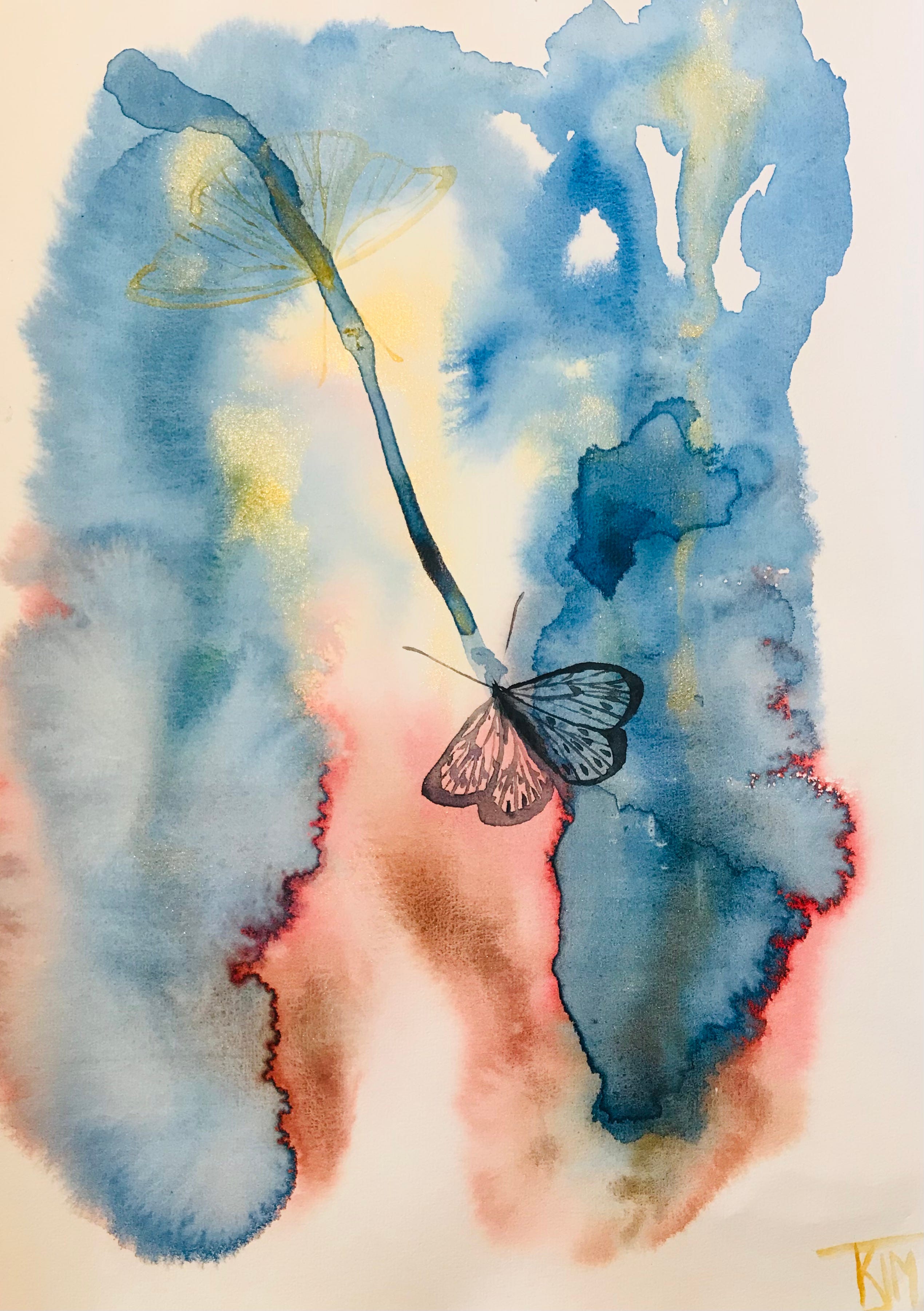
Do not be surprised if I shake. At night at the kitchen table, I paint feathers appearing and dissolving.
I finish placing the strings, with one falling straight through the centre. This central string will hold a column work: Iona Winter’s cylindrical weaving, Maniototo Redux, the mystery of the core; Johanna Qiao-Tong’s Mudra of hands over heart at the apex; and Nicolena Pine’s woven willow gold-pan at the base, a deliberate open weave.
I have a lunch box full of bull clips, two per poem, blue for the art, black for the poems. I have short strings cut to forty-two centimetres each, because I like maths to balance.
In two days time, Nicolena Pine and Kim Cope Tait will help me suspend the work inside the mountain. Poems and art which represent our gold, and our request to protect the land and surrounding water, the veins and arteries of our island. I think particularly of Mata-Au, the deep juggernaut of the Clutha which transports everything that falls into her through the landscape and out to sea. There is no safe level of arsenic in water.
Mountains become fragile when we have the power to take them down.
Throughout the days of the installation I will feel resigned, determined and helpless. I keep showing up. I’m increasingly tired. Hopelessness descends. I’m disturbed more than I want to admit by Penelope Todd’s poem Enough — the pleading, the ancient story of begging for mercy. Leda and the Swan and still not lost to myth. And Trust? Trust has been lost, in our leaders, who would allow our sacred natural places to be considered for this level of destruction. That our water could be placed in jeopardy in an earthquake prone land? And the repeating rhetoric which houses an underlying idea that something must be sacrificed: for jobs, for the economy, to get nephews off couches? It’s not 1914 anymore, it isn’t our sons who are being asked to die, just our mountains and rivers. Penelope Todd’s poem speaks to reason, to wisdom, to love. To be ignored? ‘It’s like we’re pleading on behalf of a family member,’ one man says to me on his visit to the installation.
‘What is this?’ people ask.
‘It’s a string mountain, representing the Dunstan Ranges and all we could lose,’ I say. Also it might be a request to preserve trust.
I continue to paint. Feathers and butterflies appear and dissolve.
Enough
by Penelope Todd

Life is already full enough this year —
so much (so many) to be tended,
loved, (guests) accompanied,
elderly assured — they still matter —
so many small holy jobs, practices and duties to be performed,
prayers to be done (or said),
poems to be read.

Don’t make us tired people have to beg
you few urgent men
with glints in your sights, not to
dig the ground from under us, not to
gouge again the whenua
that succours us (for loving, tending, praying, reading).

Turn away with your dynamite and diggers,
turn and lay eyes on your people,
your guests and gardens,
your old ones, and young.

Lay claim to your own terrain,
commit to the exercises, joys and devotions
of this life, your one true prospect, your gold.

Let us all settle,
let the land, too.

Settle.
*
The poetry and art installation What if the Gold needs to Stay in the Ground? closes on Thursday 2 April 2026 at 1.30pm, at 125 George Street (beside the Lollie Shop). After the installation closes, a small group of artists and poets will return the rocks to the beach.
*
Process Journal is an inner-working aspect of A History of Kindness for paid subscribers, though this one is free.
Thank you for being here.
Kirstie
Really moving, Kirstie, thank you. And for linking Penelope's poem to this loving, reverent process, the suggestion that the small holy jobs, the prayers, the poems are in some ways one, arising from the same centre, and circling out again, making, I think, inevitably, a subtle meaningful difference to the world. Yes, as her poem also suggests, this is about family and protection of the vulnerable. And so, the dogs. Shelly's old age and death, and Tiger's need for reassurance. Woven in, and essential, like the maths. Wonderful.
I loved your description of creation. I was back in Dunedin, via imagination. And then your dogs, and the rocks collected, even your balance on the ladder. Beautiful writing. Meanwhile, I'm up in Golden Bay, where locals are trying to save Sam's Creek from an Australian mining company. I wish you well.